Saturday, 26 July 2014

WIP Kaffe Fasset Tapestry Garden - Sunlight through Glass Quilt


In May 2007 my dear friend Christine and I attended a Kaffe Fassett class in Wellington.  She has blogged about it here.  It was so exciting to actually get to meet him and Brandon, and have the chance to get a few pointers on each of our quilts.  I learnt and a lot, even though some of the lessons are still being absorbed.

The class was based around the Tapestry Garden quilt first featured in 'Kaleidoscope of Quilts'.

I love the colour blending approach Kaffe Fassett employs, where by placing similar tones/colours next to one another the eye becomes confused as to where one block finishes and the next begins. 


I decided that since the quilt top itself was a learning exercise, I should continue skills building by attempting to free motion quilt it.  The down side of this admirable self imposed goal, was that the quilt top is HUGE, 241cm by 158cm.  Certainly the biggest I have ever tried to quilt myself.

Consequently my enthusiasm for the quilting has waxed and waned!


I finished sewing the top not long after the class, I think it was completed by October 2007.  I think I began quilting it in New Zealand shortly after, then stopped while we moved to Australia.  I started again in Melbourne, sometime in 2008 and did some more in Singapore in 2010 (boy was it hot!  I had air conditioner blasting and still could only manage about an hour at a time!).

Inspired by Christine, who has recently finished hers, I got mine out again, and have spent another 7 hours on it over the last week, while back in New Zealand with family.


While I have definitely made some good progress, it is still not finished.  However, I am enthused again, and my FMQ is improving. Slowly.  Parts of the quilt top are awful...but there is evidence of steady progress.

Given I am now back in Perth for a month, without my sewing machine, there will be no further progress for awhile, but I'm OK with that.  I'll aim to finish it within the next 12 months!


Friday, 25 July 2014

WIP Hand stitched hexagon Mosaic Quilt


In March 2008, not long after we moved to Melbourne, I attended a class at Patchwork on Central Park, with Adrienne Armstrong to hand stitch a hexagon quilt.

Adrienne designed the pattern based on this quilt......


featured in the book 'Historic Australian Quilts' by Dr. Annette Gero.  The original is attributed to Frederica Mary Josephson of Sydney, c1850.  (If you are unfamiliar with the books Dr. Annette Gero has published on historic Australian quilts, they are well worth checking out - beautiful quilts in beautifully produced books).

While some of the other women in the class finished making their blocks over the six weeks of the class, life got in the way for me.  I made a good start, but got nowhere close to finishing.

But I like a slow burn project....a REALLY slow burn project...so I've been stitching away ever since.  I go in bursts.  There are some periods when I make no blocks for months.  However it is a great project to take travelling, and since I'm doing a few long haul plane flights at the moment, I'm underway again.

Here are some of my earliest blocks...  I so love the wee girl in the spotted headscarf....and lots of bits of Liberty have made their way in...


Here is the detail of some of the blocks from the photo at the top.


There is an intended deign ethos - but I keep straying from it - I have always wanted the finished top to be scrappy, to have lots of interest, (Adrienne's original had some amazing fabrics that kept me looking for ages), and to have something of a vintage feel to it.   And I have tried to use scraps from many of the other quilts I have sewn while working on this, the photo below includes some of the feature second hand shirting from the quilt I made for my Dad.


The top needs 233 complete hexagons.  So far, I have made 186.   Can I just say that again.... 186 handstitched hexagons....For someone who is a little inclined to start many more things than she finishes, I'm very proud to have persisted this far). 

And I WILL finish this, because I love it.  Only 47 to go - and then the fillers for around the edges.

Here are the blocks I am working on at the moment - auditioning background.


It's all about the journey really......

Do you have any slow burn projects on the go?

Saturday, 12 July 2014

1940s smocked child's dress

I come from a long line of creative women.

I want to share some of the textile treasures we hold in the family, through my blog.  Why?
Because they are objects of beauty and careful craftsmanship, currently stored away in cupboards and drawers.  They deserve to be more widely shared.  Further, I want to create a record for family members, and as a source of personal inspiration.

The first of these vintage textile treasures I want to share is a smocked dress, made for my mother, Wendy Williams, in circa 1942- 1945.


This dress is made from trabalco.  A fabric I had never heard of before.  It has the appearance of cotton.  I can find advertisements for trabalco fabric in womens periodicals from about 1919 - 1940 but no further information.  My mother has told me that trabalco was often used for childrens clothing in the war years when few floral cottons were available.  She remembers this dress as being well starched and somewhat scratchy to wear!

The dress was smocked by my grandmother Dinah Williams (nee Sloman) and sewn up by my great grandmother, Esme Sloman (nee Sommerville, b December 1886, d 1959).  My grandmother, who we called Gee, enjoyed smocking, tabestry and knitting.  I can recall her hand stitching, but never saw her sit at a sewing machine, and am not certain if she even owned one.  But she had little need to, since my great grandmother, known as Gargee, sewed clothes beautifully.


In this photo you can see my grandmother and three of her four children.  My mother is second from the left.  Both she had her sister are wearing smocked dresses, similar to the one featured in this post.

The dress would fit a little girl between about 3 and 6.  It has a chest size of 60 cm.  It is machine sewn with beautiful French seams at both sleeve and side seams.  It buttons down the back (8 green buttons, now faded), and is smocked front and back.  The dress has cream (now discoloured) collar and cuffs edged with blue blanket stitching.  It has a small hem, only 1cm, and shows no signs that the hem has been let down at any stage.  (It was common to make smocked dresses with big hems that could be let down so the child could continue to wear then as they grew).


The fabric on the outside of the dress is faded from the bright Kiwi sun.  But on the inside the colours are still bright.


I love the colours of this dress, picked up in the smocking, so bright and pretty.


The smocking is 10cm (4inches) deep, in 6 colours; dark navy, white, mid pink, yellow, green, mid blue.  There are 7 bands of smocking ranging from 1-6 rows of stitching in each band, using three stitches stem, cable and wave stitch, with a mirror image repeat from the 6 rows of blue wave stitch in the centre.


My favourite part of this dress is where it has been invisibly mended.  At some point the dress has had a deep rip, down the edge of the back placket, from between the 6th and 7th buttonhole almost to the hem of the dress.  My great grandmother has carefully repaired this rip, using herringbone stitch on the inside, and covering this on the outside, by a piece of fabric, perfectly aligned, appliquéd over the rip, making the mend almost invisible.  It speaks of such care and pride in the work and the importance of ensuring a wartime dress can continue to be worn.

This is the mend from the inside...


And this is what you can see on the outside...


The dress is too fragile now to be worn.

At some stage I want to use the colours, the squares of the gingham, and maybe the patterns of the smocking as inspiration for a quilt.  Perhaps a mini quilt?


Thursday, 26 June 2014

2012 finish - 'Fencing in' for Gavin

This is a quilt I made for my Dad in November 2012 (for his birthday in December), before I started blogging.  I spent some time with my parents recently so took the chance to get some photos of it.

 
It is a slightly adapted version of Denyse Schmidt's 'Basketweave' quilt from her book, 'Modern Quilts: Tradional Inspiration'.  The slight change I made was to cut each rail slightly smaller than recommended in the pattern (only I can't find the notes to see what size!), I did this to maximise the number of pieces I could cut from the secondhand shirt I was using (its the green and cream fabric).

The quilt started with the striped (cream, green, dark brown and mid blue) fabric that was purchased as a second hand man's shirt from an St Vincents Opportunity Shop in Melbourne.  I LOVE secondhand man's shirts - they come in great colours, are soft from some wear, pure cotton and you get heaps of fabric for a tiny price!


The dark blue fabric is from another secondhand shirt, and the brown is a lovely linen, from the new shirting remnants my girlfriend bought me in Singapore.  The rest of the fabrics are from Amitie in Melbourne, one of my very favourite fabric shops.


I quilted this myself.  First I ditch stitched the whole quilt, then I did some FMQ, but not much as I wanted it to stay soft and drape well.  My Dad is a man of plain tastes, so I didn't want to the quilt to get too fussy.  I used a stylised chain fence design on all the plain blue blocks, placed anywhere in the block that felt right, but continuing that same line across all blue blocks in that row or column....


...echo quilting around the circles and diamonds for the fabric below....


...and a stylised vine or tree design on the green and while dot fabric


I used an old doily for the label on the back, and carefully unpicked and attached the labels from the shirt that had been part of my inspiration.  (The labels from the navy shirt had already been included in a previous quilt that it was partially used for).


I had to include this last photo because of the lamb in the background, I guess spring is arriving in New Zealand!


Cross Currents for Kate quilt top finished!

I'm so pleased to finish this quilt top.   For all sorts of reasons, not least that I now have some chance of getting it to my niece in time for her birthday.  But it also means that it won't need to be all packed away, incomplete, in readiness for our move to Perth, and remain untouched for some months.

It's entirely my own design and I'm thrilled with how it has turned out....


The shape looks a little odd in this photo, and the light is not great (very overcast winter day here) - but I assure you it is my bad photography skills!  I know its squared up because darn it - it took me ages but it is close to perfect!

Boy getting those angled pieces set in was challenging, lots of Y seams, but the hardest part was getting all the right dimensions for the long rows of fabric (given my haphazard designing was almost completely by eye), and then getting everything sewn together, flat, in the centre.  (This doesn't really make sense but trust me, there was more than a few moments when I was ready to tear my hair out!).

Some details I am particularly proud of...the single yacht, sailing all by itself in the top centre (there's always one..),


...the lone seagull in the bottom left hand side (seem best in the top photo), and the dolphin in the bottom right, (you can't have a sea quilt without a dolphin!).


And finally - by complete luck - call it serendipity - the quilt has ended up with a large 'K' for Kate, in the centre bottom, created by the two (and a bit) scrappy trip blocks...I didn't even realise this until I looked at the photos.  Meant to be I think!


It's now away with Sue Burnett to be custom quilted. 

Monday, 23 June 2014

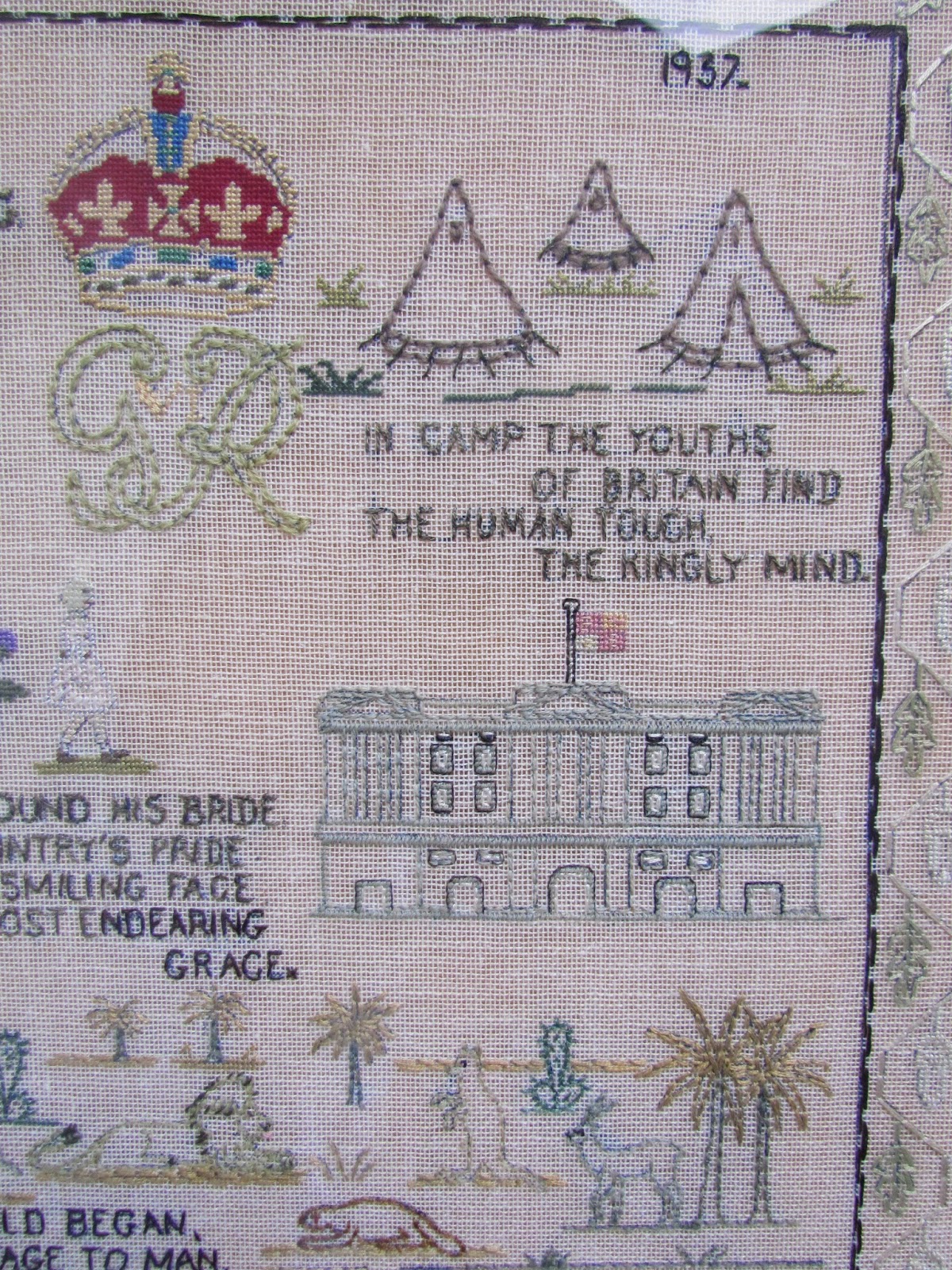
1937 Empire tabestry sampler for Wendy

This family treasure is a tabestry sampler done on linen by Gladys Sommerville between 1937 and 1945, for her great neice, my mother Wendy.


Gladys was a formidable woman!  She was briefly engaged in 1901 but the wedding did not proceed and family history does not relate why.  However, she went on to found a very sucessfully private boys preparatory school (which is still in operation today, celebrating 100 years in 2015).  She was a prolific needlewoman and we have a number of pieces she has made still in the family.

The sampler is big, measuring 51cm long by 40 cm wide.

The colours have faded considerably now, but were once very vibrant.

We are unsure whether she followed a pattern, or designed this piece herself.  The verse, which is very much of its time, reflecting the way New Zealanders saw themselves as a outpost of mother England, reads:

'For George VI our Emperor King,
the bells throughout the Empire ring,
In stitchery, we here record,
the crowning of our soverign lord


In his own realm he found his bride,
Beloved Queen, our country's pride,
Each daughter in her smiling face,
Shows childhoods most endearing grace.

Never since the world began
Came greater heritage to man
Empire and the motherland
In common cause together stand.

Peace from the cares of state
Once through the garden gate.


In camp the youths of Britain find,
the human touch, the kingly mind,


Good health unto their majesties
with honour, happiness and peace,
uncounted loyal subjects sing,
long may he reign, God Save the King!'


Images include Buckingham Palace, Princesses Elizabeth and Margaret, and the gate that lead into their personal garden, boy scout tents, a septre and orb, a beefeater guard, and my personal favourite,
a range of animals representing the various countries of the Commonwealth; elephant, kiwi, lion, kangaroo, springbok and a playpus!


The border is repeated images of oak leaf and acorn.

My mother remembers that during the war years, she would often read through the verses with her grandmother (Glady's sister) like a prayer. 

For much of my childhood it was on the wall in one of our toilets (away from the light)!  As a result, my sister and I memorised it in the many hours we spent hiding from doing the dishes, and as a result, could recite the verses from memory!

A companion piece, showing a map of the British Empire, was also made by Gladys, for Peter, my mother's twin brother.


Mrs Sinclair's Suitcase by Louise Walters

I really enjoyed this book.

For starters it is another book set in a bookshop (head start in the good reading stakes).  But it is also well written, some lovely descriptive passages, interesting characters and avoids (most of) the clichéd plot twists of a novel with a romance.

Roberta works in the Old and New bookshop, owned by Phillip, along with a couple of other woman.  She is particularly fond of the notes and letters that people hide in their books and forget to remove.  Whenever a note is found in a book bought in for sale, she collects the note up and takes it home.  Then one day her father, John, brings in some of her grandmother's books.  One of them includes a letter to her grandmother, from 1941, from Jan Pietrykowski, Roberta's grandfather.  However the contents of the letter do not marry with family history.  The plot follows Roberta's attempts to solve the mystery, interspersed with flashbacks to her grandmothers life as a young married woman, whose husband is away fighting in WW2.

I read this quickly, carried along wanting to know how the story would end.

Recommended.